Project Lichen
Liberating Land and Living Systems Because If You Eat You're In (Thanks IE. Todmorden)

If You Eat You’re In
A city, suspended in the air.
Seemingly solid, confident, illuminated. Seemingly…
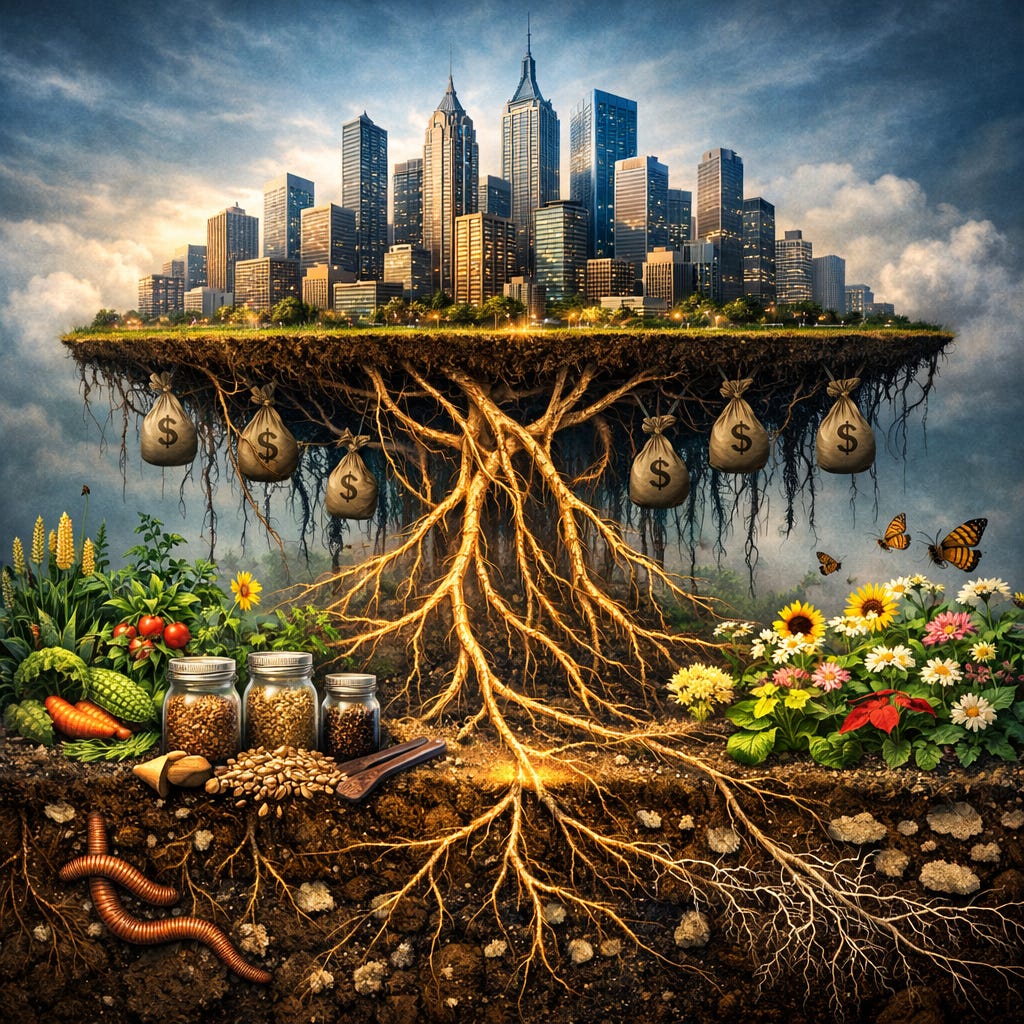
Beneath it—barely visible at first—threads descend. Not cables, not steel, but living roots. They reach down into soil rich with life: seeds resting, fungi weaving, insects moving, water cycling quietly through darkness. Pollinators move above that soil, unseen by the city, yet essential to everything it assumes will continue.
The city believes itself independent.
The roots know otherwise because as our good friends at Incredible Edible Todmorden coined such a powerful phrase; “If You Eat You’re In!”.
Project Lichen
Project Lichen is a framework for reconnecting living systems, energy systems, human coordination, land use, technology and governance into one coherent design. We already have many pieces in place and working; the most active part of this, being The Fabaceae Food Forest; we introduced this concept here.
This city image (above) has stayed with me for some time now; having lived in Los Angeles, previously, for 22 years. It is not just a metaphor—it is a description of how much of our modern world now operates. Systems built above, disconnected from the living foundations that sustain them. Food grown at great distance “Studies estimate that processed food in the United States travels over 1,300 miles, and fresh produce travels over 1,500 miles, before being consumed”. Communication routed through invisible infrastructure far beyond local control. Value measured in abstractions, while the sources of life—soil, seed, water—are treated as background conditions, or worse, externalities.
And yet, beneath all of this, the living systems persist.
They always have and always will.
I have spent the past 14 years working closely with seeds. Saving them, planting them, observing them, sharing them. A lot of this work, we are documenting in The Secret Life Of Seeds. In doing so, something becomes very clear:
Seeds do not operate on centralized systems.
They are inherently distributed.
They adapt locally.
They store memory across time.
They move when conditions allow, not when commanded.
In other words, they already embody many of the properties we are now trying to recreate in our technological systems.
The Lichen Aspects
Project Lichen begins from this simple observation.
Lichens themselves are remarkable organisms. Not a single entity, but a partnership—fungus and algae (or cyanobacteria), living together in a form that allows them to survive in places where neither could alone. They grow slowly. They persist. They do not dominate environments; they inhabit them, stabilize them, and often prepare the way for other life.
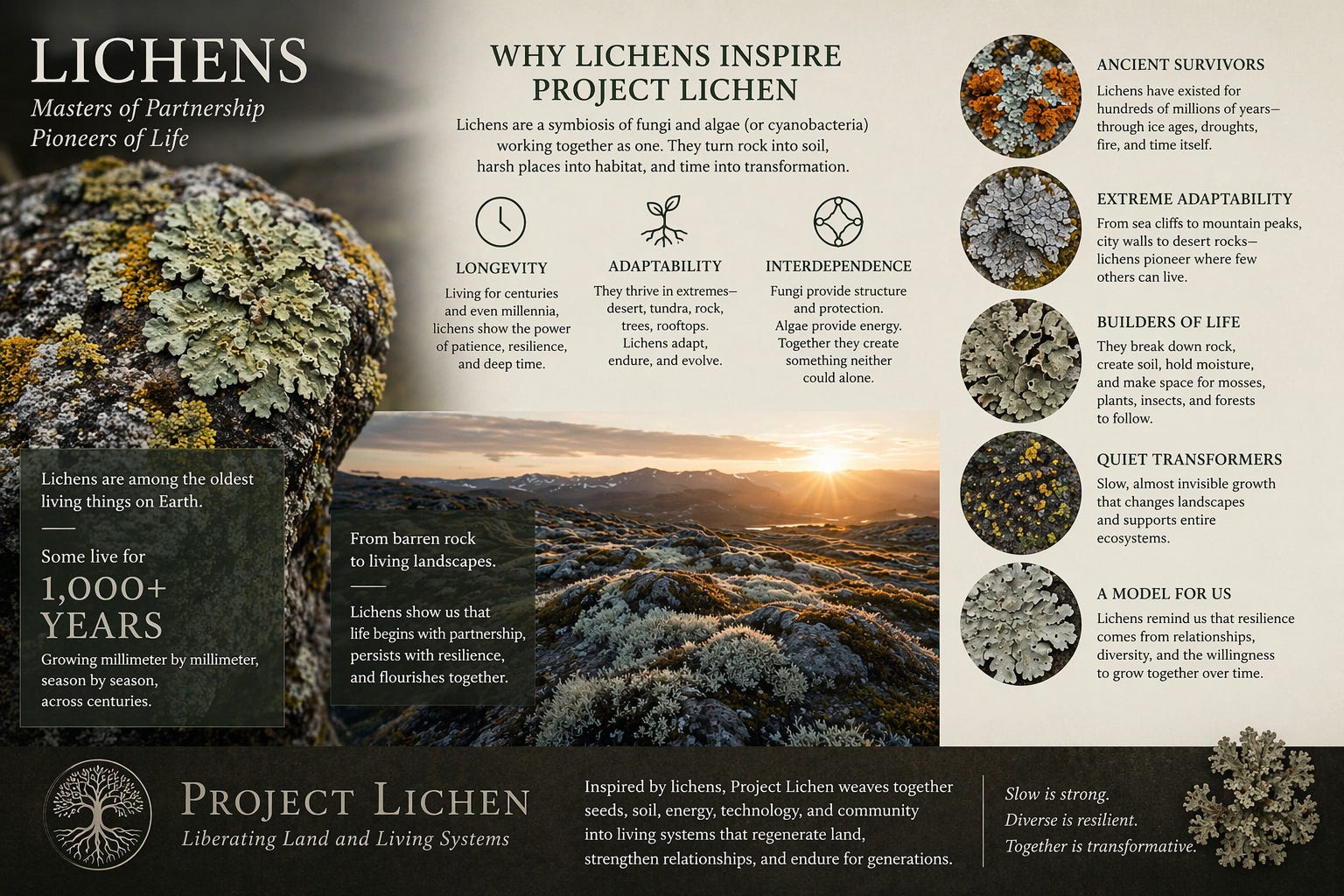
They are, in many ways, a model of cooperative resilience.
Project Lichen takes its name from this.
Not because we are trying to replicate lichens directly, but because we are trying to learn from the pattern they represent:
A system that emerges from cooperation.
A system that does not depend on centralized control.
A system that can persist under difficult conditions.
As I have explored this further, I’ve come to realize that these principles are not limited to biology.
We see them in older human systems too.
Consider the ancient stone aquaculture systems found in various parts of the world. Carefully arranged rocks forming channels and enclosures along tidal zones or riverbanks. No pumps, no engines, no central control. And yet, these systems worked—often for generations.
They worked because they did not try to control the flow.
They shaped it.
Water moved as it always does. Fish followed natural patterns. The structure simply guided that movement, creating conditions where abundance could be harvested without destroying the system itself.
This is a very different way of thinking.
Instead of asking:
“How do we control the system?”
It asks:
“What structure allows the right outcomes to emerge naturally?”
Project Lichen applies this thinking to modern challenges.
Project Lichen is a living systems framework for restoring land, food, and human coordination through the integration of biology, energy, technology, and community. A main unifying point is that Project Lichen is intensely locally focused and this is achieved by the creation of a complete communication-governance-logistics system allowing a decoupling of the current reliance on long-distance food supplies. Also the current deep dependence on similarly long distance inputs such as chemical fertilizers-pesticides etc. Project Lichen is divided into units of 1 acre (aka as a Project Lichen Unit) which can be scaled up or down and the principles are based on empirical working examples.
At one level, it is a technological project. It involves devices, software, communication layers, and data structures. There are nodes—phones, small local servers, seed vaults. There are agents that observe, synchronize, and route information. There are schemas that describe how knowledge is stored and shared.
But if we stop there, we miss the point.
Because at a deeper level, Project Lichen is about how systems are designed to behave.
The Lichen Unit (1 Acre of Living Infrastructure)
Project Lichen is not only a framework.
It is grounded in something very simple:
An acre of land which can be scaled up or down.
A Project Lichen Unit is a one-acre system designed to integrate food production, seed saving, water management, and local resilience into a single living structure.
Not as separate elements—but as one continuous process.
In practice, these systems are not theoretical.
The area currently under development represents an early-stage implementation of a Lichen Unit.
Across this section of land, a series of eleven smaller hugelkultur mounds have been constructed, each approximately 12 feet long, 4 feet wide, and between 2 and 3 feet high. In addition, two larger mounds—approximately 24 feet long, 6 feet wide, and 5 feet high—form deeper structural elements within the system.
Taken together, this represents on the order of 70 cubic yards of integrated biological structure, composed of wood, manure, soil, and organic matter.
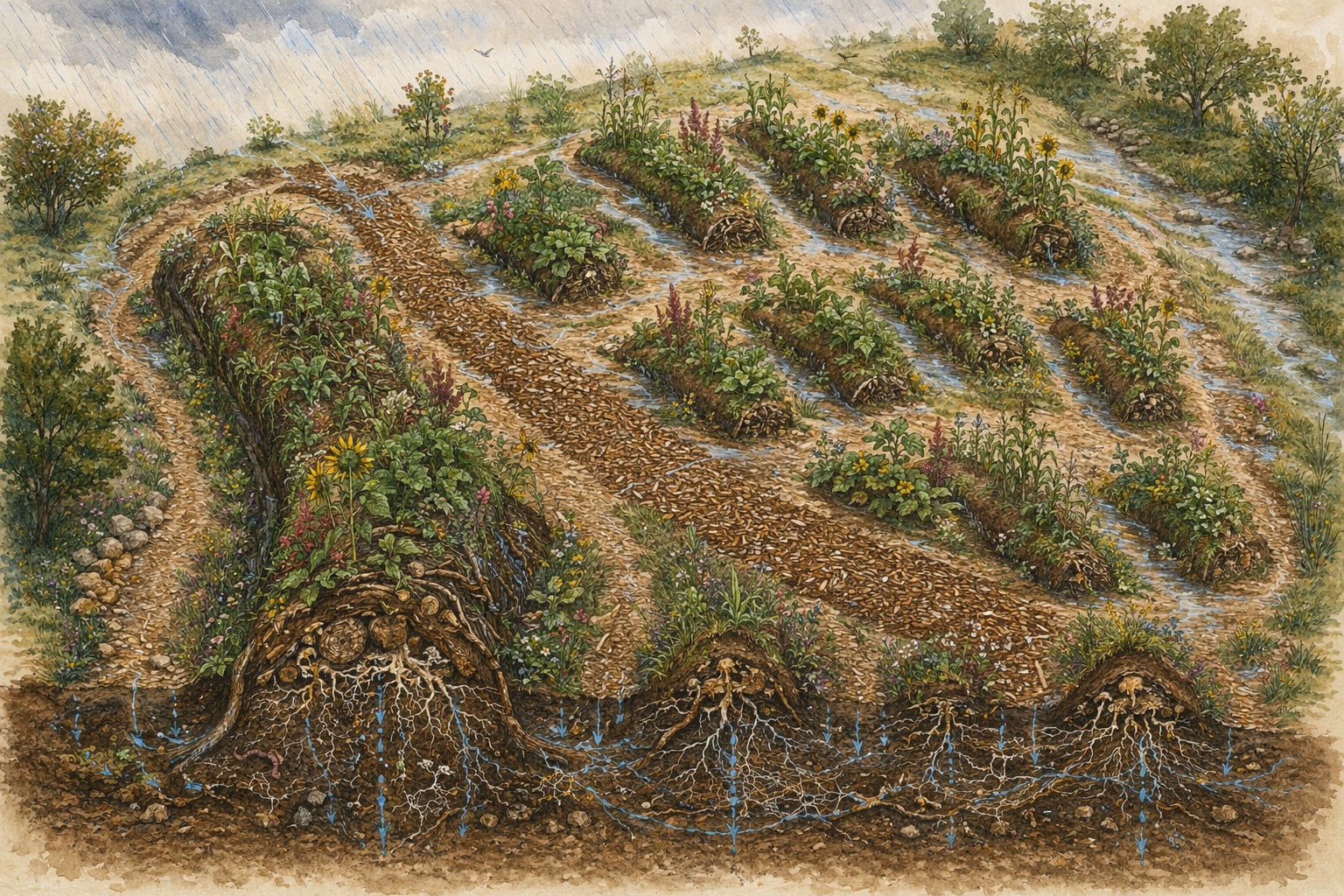
In addition to the mounds, a network of woodchip pathways has been established. A primary path, approximately 10 feet wide, 135 feet long, and around 4 inches deep, runs through the system, with connecting paths forming a continuous layer.
This adds a further ~30 cubic yards of woody material, bringing the total to approximately 100 cubic yards of integrated organic structure already in place.
These are not isolated beds.
They are arranged across the natural slope of the land, which runs from west to east. Rather than allowing water to pass through in a single movement, the system interrupts and absorbs that flow repeatedly.
Rainfall is slowed, captured, and redistributed.
Woodchip pathways act as sponges. Hugelkultur mounds act as both drainage buffers during heavy rainfall and moisture reservoirs during dry periods.
The system begins to behave differently.
Instead of shedding water, it holds it.
Instead of concentrating flow, it softens and spreads it.
At the biological level, the system is centered around the Fabaceae Food Forest, with fava beans as a key species. Their ability to be planted in both autumn and spring allows for near-continuous root presence, supporting nitrogen cycling, soil structure, and seasonal continuity.
Companion species—including amaranth, sorghum, sunflowers, and squash—add layers of food production, biomass, and ecological function.
This is not simply a garden.
It is a hydrological and biological system.
Water is not applied—it is captured and moderated.
Fertility is not imported—it is grown and accumulated.
Waste is not discarded—it is reintegrated.
Food waste streams, along with manure and woody materials, are transformed into soil. That soil, in turn, supports the next generation of seeds and food.
The system is not designed for ideal conditions.
It is designed for variability.
Heavy rainfall is absorbed.
Dry periods are buffered.
The system does not eliminate extremes—it learns to live through them.
Each acre becomes both:
a local food and seed system
and a node in a wider, distributed network
Dielectrics In Soils
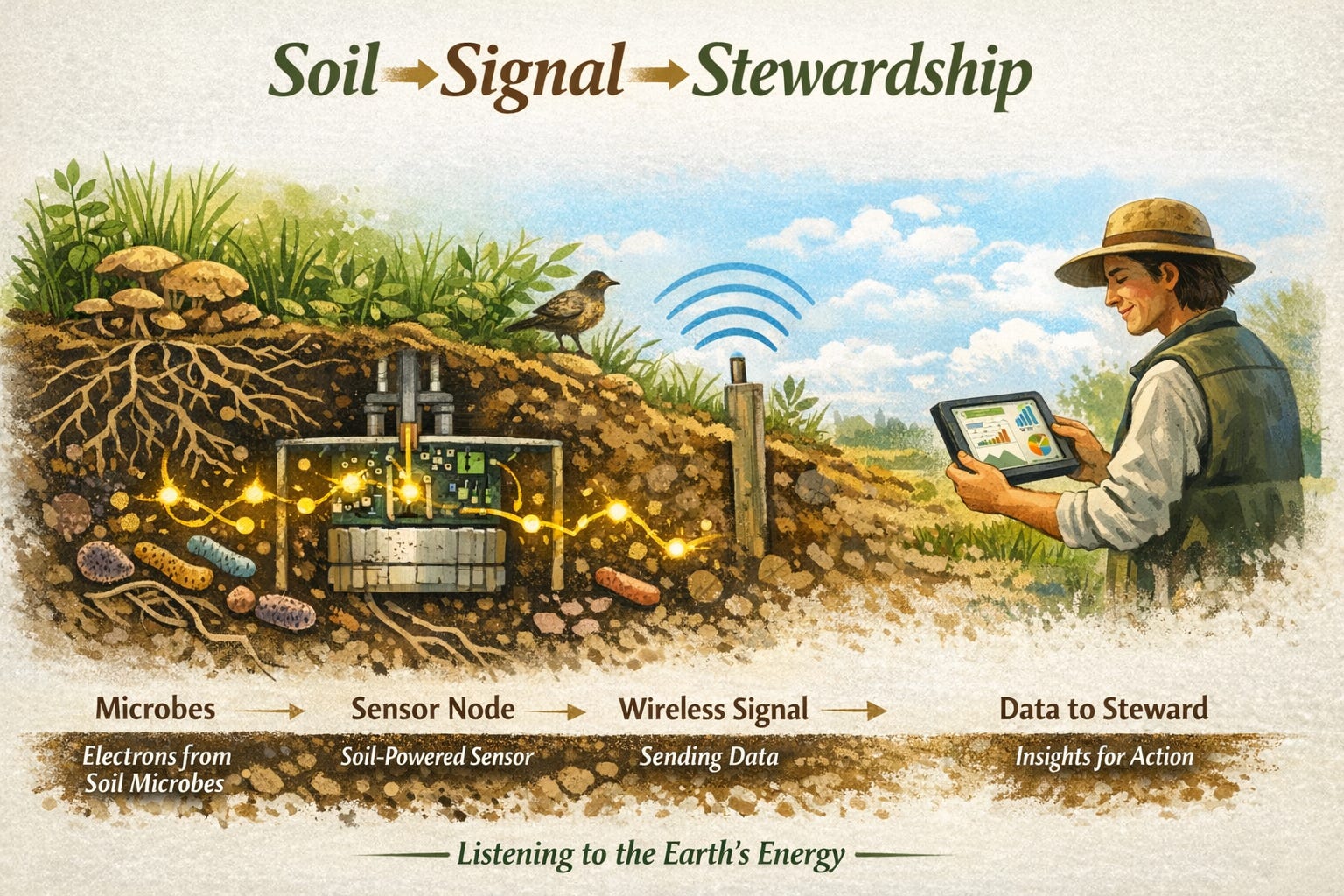
Recently, researchers demonstrated something both simple and extraordinary: the soil itself can generate electricity.
Not through industrial intervention, but through the quiet work of microbes breaking down organic matter, releasing electrons, and sustaining a small but continuous current.
Enough to power sensors.
Enough to transmit signals.
Enough, in effect, for the land to begin speaking.
This is not an energy system we have invented. It is one we are only just beginning to recognize.
In Project Lichen terms, this is deeply significant.
It suggests that what we have called “Layer 0”—the living substrate of seeds, soil, and microbes— is already expressing “Layer 1”: energy.
The boundary between life and infrastructure dissolves. The question is no longer how to power our systems.
The question becomes:
How do we listen to the systems already powered by life?
We will give more details on this soon.
Communication
Most modern digital systems assume constant connectivity. They assume central coordination. They assume that everything important must pass through a small number of controlled points. Cloud computing is a classic example of this.
This works—until it doesn’t.
When connectivity is lost, systems fail.
When central services are unavailable, processes stop.
When scale increases beyond control, complexity becomes fragility.
In contrast, a lichen-like system assumes something very different:
Connectivity is intermittent.
Nodes are autonomous.
Information moves when it can.
This is sometimes called delay-tolerant communication, but the name is less important than the principle:
A message does not need to arrive instantly to be part of a living system.
It only needs to arrive eventually.
In practical terms, this means a phone in a field can record an observation without needing a network. That information can later synchronize with a nearby local node—a small device, perhaps a Raspberry Pi—when the opportunity arises. That node, in turn, can pass information along to a larger seed vault system, or to another node entirely, through whatever path is available: Wi-Fi, radio, or even physical transfer. We have a comprehensive and evolving Github repository for the technologies behind Project Lichen.
No single path is required.
No central authority is necessary.
The system works because it is structured to allow flow.
Governance Systems
The same thinking applies to governance.
Project Lichen does not assume a single decision-making center. Instead, it explores approaches such as fractal sortition—distributed, layered participation where decisions are made at the lowest appropriate level, and only escalated when necessary.
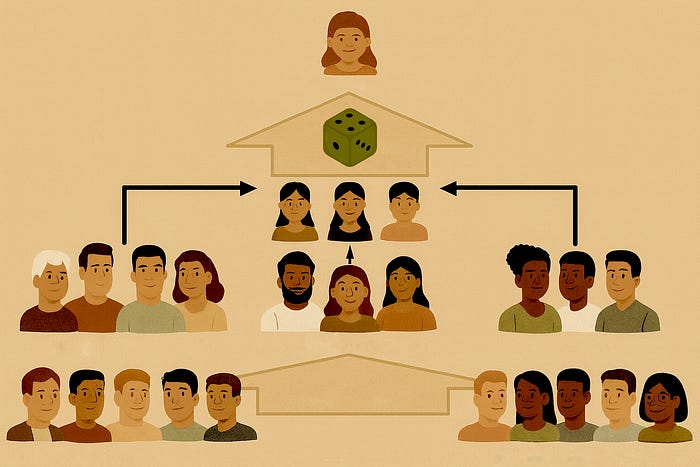
This reflects a principle long present in ecological systems:
Local conditions are best understood locally.
Higher-level coordination exists, but it does not replace local knowledge. It builds upon it.
All of this may sound abstract, but it is grounded in very real concerns.
Food systems that depend on long-distance supply chains are fragile.
Seed diversity concentrated in a few locations is at risk, particularly via patenting and GMO based practices. Communication systems dependent on centralized infrastructure can fail in ways that are difficult to recover from.
At the same time, we have access to tools—both biological and technological—that can support more resilient approaches.
Seeds that can be saved and shared locally.
Low-power devices that can operate without constant connectivity.
Communication systems that can route information dynamically across different interfaces.
The question is not whether these tools exist.
It is whether we choose to structure them in ways that support life, rather than abstract control.
Project Lichen is one attempt to do that.
It is not a finished system. It is not a product. It is a direction—a way of thinking about how land, seeds, people, and technology might be brought into better alignment.
It asks:
What would a system look like if it did not need permission to exist?
What would it look like if it could continue under conditions of disruption?
What would it look like if it placed living systems at its foundation, rather than treating them as an afterthought?
We are not building a system to control the world, we are building one that can continue when control fails.
And like the lichen itself, it may grow slowly at first—almost unnoticed.
But given time, and the right conditions, it can persist over eons and it begins to do what living systems have always done.
It stabilizes - It connects - It prepares the ground for what comes next.
We may find, in the years ahead, that the most resilient systems are not the most complex, nor the most centralized, nor even the most technologically advanced.
They are the ones that remember how to begin.
With soil.
With seed.
With place.
And with the quiet understanding that life does not need permission to organize itself.
Project Lichen is simply an attempt to listen to that—and to build accordingly. We have much to post on the Project Lichen project and as stated above, parts of it are already in place and all of it is based on 30 years in technology and 14 years in Permaculture projects on both side of the Pacific Ocean.
Thank you for reading our ongoing articles, as always.